
Are You an Imposter?
Navigating the shifting demands at work

It’s not lost on me that there’s an odd juxtaposition between my kids playing the game “Imposter” with joyful abandon while my clients wrestle with imposter syndrome in their careers. Children easily make a game out of pretending to be something they’re not; adults, on the other hand, are wracked with guilt over the risk of being found a fraud.
None of us was born an expert. And we’re all facing an onslaught of new, never-before-seen challenges.
In general, we learn through experience, trial and error, and the integration of feedback along the way. When we say yes to opportunities that present themselves, it’s on us to apply discipline, resilience, and stick-to-itiveness to face what comes next.
Succumbing to imposter syndrome robs us of that ability. It cripples our capacity to apply constructive feedback. It paralyzes us when adaptive movement is essential. And it steals any chance of enjoying the game we’re actually playing — stepping into an elevated role, leading through change, or simply modeling the confidence required to do hard things.
The sneakiness of imposter syndrome might look like:
Self-doubt that you’re the right person for the job
Insecurity when making decisions
Second-guessing your instincts
Retreating to routines and what you know you do well, even when it’s not the highest and best use of your time
Buckling under the pressure of new challenges
Withdrawing from or avoiding difficult conversations
Micromanaging or trying to overly control situations and people
I’ve watched kids play Imposter with fearless glee. The stakes are admittedly different, but seeing them assert their roles with conviction feels triumphant — even when they’re dancing dangerously close to deception.
I’m not advocating for dishonesty or lack of integrity. And being vulnerable about our insecurities can absolutely be a sign of strength. But sometimes we need to muster the courage and belief that we have what it takes before we’ve fully convinced ourselves.
Here’s an example. Last week, I watched my son’s Little League team battle courageously in the playoffs. In one game, the opposing pitcher was visibly struggling. After walking a few batters, he gave up a hit that sent kid after kid crossing home plate.
As tears rolled down his face, he fought to find his composure. I was struck by his coach and parents resisting the natural urge to come to his rescue. Instead, after a few words of encouragement and a pat on the back, that 8-year-old figured out how to get out of the jam. He’s stronger for it now — the start of a helpful callus for when the going gets tough.
In our professional lives, we’re all developing new and uncomfortable calluses. New workflows with technology have us shifting from human interactions to extensive back-and-forths with AI tools. And amid that shift, there’s a factor of isolation that must not go ignored.
Business Insider’s The Antisocial Workplace reveals a real risk of loneliness as AI boosts productivity. Answers that once emerged from cross-functional conversations get displaced by an AI agent’s instant computation. Human connection is lost. And for many of us who find meaning through collaboration, those fraying relationships quietly deplete our sense of community.
Maybe we’re all on that pitching mound right now — flinging the ball and hoping it finds the strike zone. Like developing any new skill, it’s uncomfortable. We can take a deep breath. Get grounded. Focus on our form.
Amid feelings of uncertainty, overwhelm, and change fatigue, let’s not forget to tap into our creativity — the uniquely human experiences that shape us. A recent piece in The New York Times highlighted a study of over 370,000 student essays written with generative AI assistance. While they showed a boost in readability and colorful language, they also revealed a significant lack of original creative ideas compared to essays written solely by humans.
If creative disruption and innovation remain the goal, keep the humans in the loop.
All of this to say: if you feel like an imposter these days, welcome. You are not alone.
If you’re on that pitching mound with tears streaming down your face — take a deep breath.
Keep creating from your uniquely human experiences. Keep feeling the ball nestled in your glove and the packed dirt under your cleats. You may give up some runs. You may feel the weight of the game on your shoulders.
But your team believes in you. Your coach believes in you.
You need to believe in you.
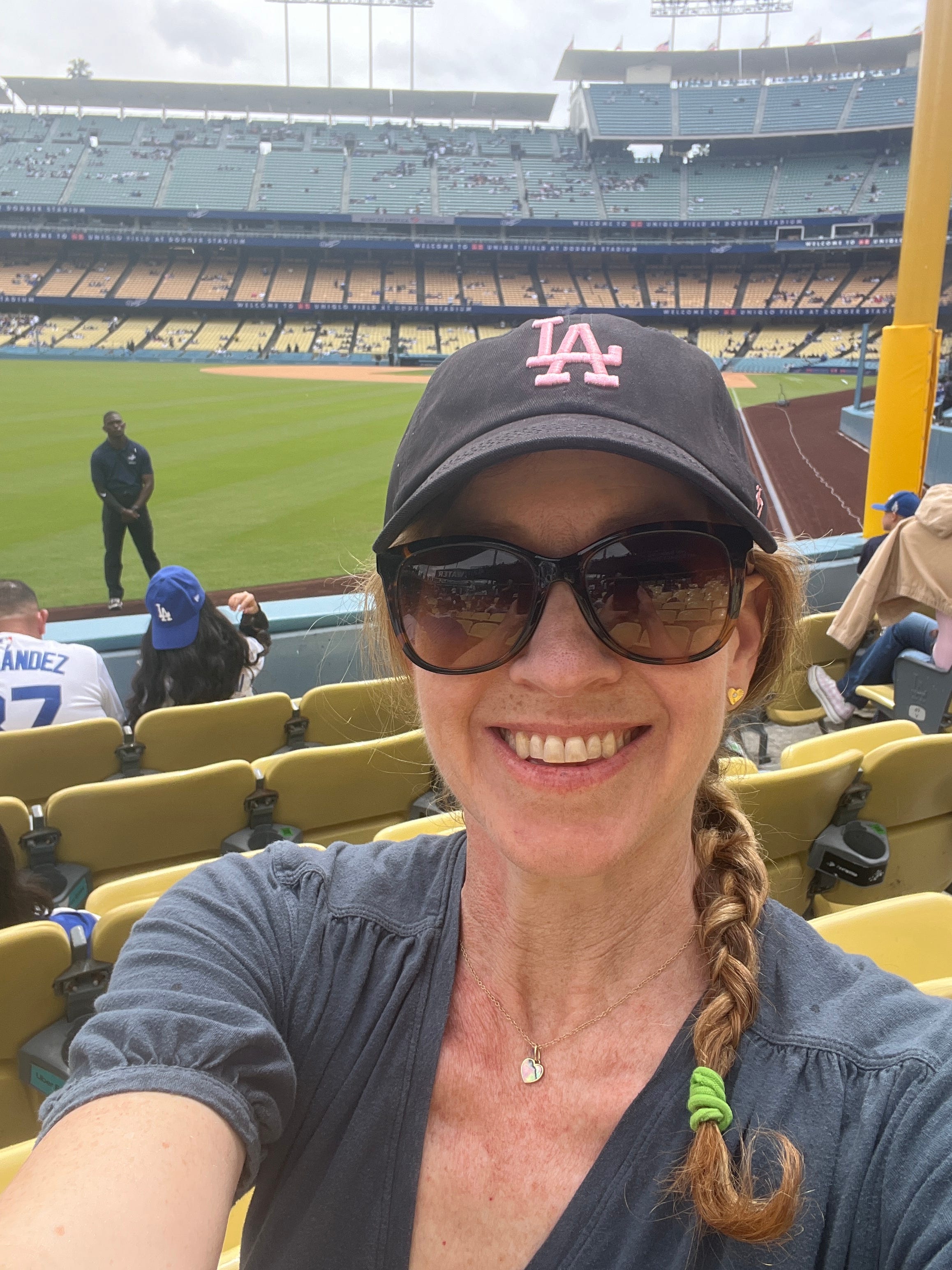
Me at Dodgers Stadium, before realizing we were in the wrong seats. :)